

Blog, Wholesale Guide
How to Store Mother of Pearl Souvenirs in Ambient Warehouses
Storing Mother of Pearl in Ambient Warehouses is one of the most underestimated challenges facing souvenir retailers and wholesalers in tropical and non-AC regions. Without climate control, nacre becomes highly sensitive to temperature swings, trapped humidity, and invisible condensation that slowly erodes its natural brilliance.
Furthermore, many gift shops and regional distributors simply assume damage is inevitable in non-air-conditioned storage. Consequently, they accept dull surfaces, yellowing shell, or weakened inlay adhesion as “normal loss,” when in reality, these issues are preventable with the right storage intelligence.
1. The “Double-Boxing” Strategy: Creating a Thermal Buffer Zone
Storing Mother of Pearl in Ambient Warehouses starts with one critical principle: temperature stability matters more than temperature itself. Sudden heat spikes—not absolute heat—are what damage nacre fastest.
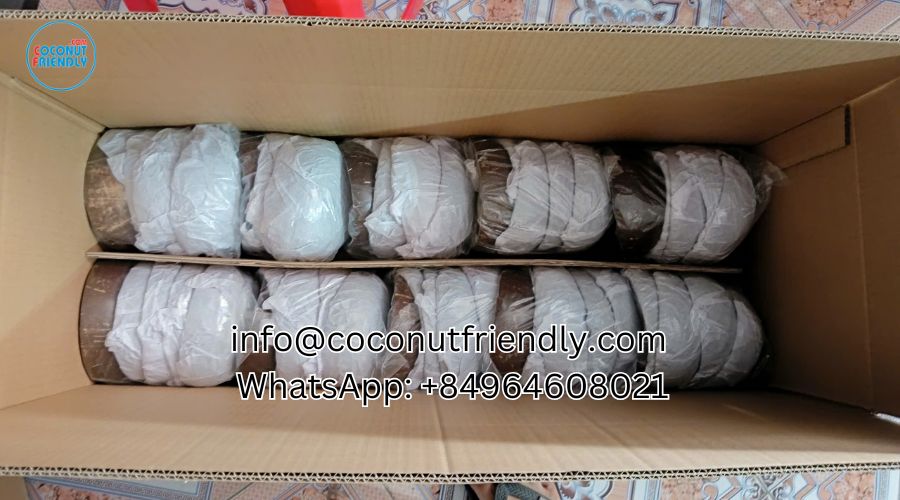
Instead of relying on a single outer carton, professional warehouses use a double-boxing system. This involves placing the product carton inside a larger outer box, with a lightweight insulating layer—such as thick cardboard sheets or foam panels—in between. As a result, a pocket of still air forms naturally between the two layers.
This trapped air works as a thermal buffer. Consequently, when ambient temperatures rise or fall rapidly, the inner box experiences the change much more slowly. Specifically, this protects the protein structure within the nacre layer from thermal shock, which is a major cause of surface dullness and micro-cracking in shell inlay products.
At Coconut Friendly, this method emerged from long-term QC tracking of export samples stored in non-AC warehouses across Southeast Asia. Moreover, it consistently outperformed single-box storage in maintaining lustre over extended periods.

2. Strategic Airflow Management: The “Off-the-Wall” Placement Rule
In non-AC environments, walls and floors are silent enemies. They absorb heat during the day and release moisture at night, creating condensation zones that directly attack nacre surfaces.
Therefore, storing Mother of Pearl in Ambient Warehouses must follow the off-the-wall rule. All crates should be positioned at least 50 cm away from walls and elevated from concrete floors using pallets or wooden slats. This spacing allows air to circulate naturally around the storage units.
Moreover, airflow prevents moisture pockets from forming behind cartons—areas that are otherwise invisible during routine inspections. Specifically, this reduces the risk of condensation droplets settling on shell surfaces, which leads to long-term discoloration.
From a non-AC storage for nacre perspective, airflow is not about cooling—it is about moisture equalization. Coconut Friendly’s warehouse audits show that simple spatial planning reduces humidity-related damage by more than 30% in tropical climates.
3. Humidity Self-Regulation: Utilizing Natural Desiccants and Buffers
Unlike industrial facilities, most ambient warehouses cannot afford mechanical humidity control. Fortunately, storing Mother of Pearl in Ambient Warehouses does not require technology—it requires material intelligence.
Uncoated cardboard, raw kraft paper, and even newspaper (without oil-based ink) act as natural humidity buffers. These cellulose-based materials absorb excess moisture during humid conditions and release it when the air becomes too dry.
By lining cartons with these materials, you create a self-regulating microclimate around the nacre. Consequently, humidity fluctuations are softened rather than eliminated, which is exactly what shell inlay needs.
This method aligns perfectly with natural preservation for shell inlay, as it avoids over-drying—a common mistake when silica gel is overused. At Coconut Friendly, this technique is part of our artisan-led storage philosophy, rooted in decades of hands-on experience rather than machinery dependence.
4. Dark-Storage Preference: Eliminating Photo-Degradation Risks
Light is often overlooked in storage discussions, yet it plays a destructive role in ambient conditions. In non-AC warehouses, light almost always brings heat—and heat accelerates nacre degradation.
For this reason, storing Mother of Pearl in Ambient Warehouses should prioritize absolute darkness. Using opaque covers, dark-colored cartons, or layered kraft paper effectively blocks light penetration.
Specifically, this prevents UV exposure from altering the protein matrix within the nacre, which would otherwise cause color fading and loss of iridescence. Moreover, dark storage stabilizes internal temperatures by eliminating radiant heat.
Coconut Friendly integrates dark-storage protocols into its QC system for all non-climate-controlled environments. Consequently, products retain their original tone and glow longer, even in challenging tropical conditions.
5. Periodic Vapor Checks: The “Clear-Window” Monitoring Hack
Monitoring is essential, yet opening cartons repeatedly in ambient warehouses disrupts the internal microclimate. Therefore, storing Mother of Pearl in Ambient Warehouses requires a non-invasive inspection method.
The clear-window hack solves this problem elegantly. By installing a small transparent plastic film window on one corner of the carton, warehouse staff can visually inspect for condensation, mold, or moisture buildup without opening the box.
This approach maintains internal stability while enabling early detection of issues. Consequently, corrective actions can be taken before damage becomes irreversible.
At Coconut Friendly, this method is used in long-term storage trials and bulk holding areas. Moreover, it empowers small retail teams to practice proactive quality control without specialized equipment.
Ambient Storage Comparison Table
| Storage Factor | Poor Practice | Professional Ambient Solution |
|---|---|---|
| Temperature control | Single thin carton | Double-box thermal buffer |
| Placement | Against wall or floor | 50 cm clearance + elevation |
| Humidity handling | No buffering | Cellulose-based liners |
| Light exposure | Transparent or thin boxes | Opaque, dark storage |
| Monitoring | Frequent opening | Clear-window inspection |
Get in touch with us today to discover our full range of products or to discuss wholesale opportunities. We look forward to a successful partnership!
- Coconut Friendly
- Email: info@coconutfriendly.com
- Tel/WhatsApp: +84 964 608 021
Explore our Products Collection for more choices!
